Nov 11, 2026 · Updated Nov 13, 2026
The Well: how an AI short reads as cinema
An award-winning AI short measured shot by shot: 122 shots, two reused camera set-ups, straight cuts only, a human score, and the record of how it was made.
Question: "The Well" by Dorian & Daniel took Gold at Runway's AI Festival 2026: five and a half minutes of snowbound crime drama played by a hare, a lynx, a wolf and a family of goats, with dialogue that sounds acted and pictures that look photographed. How was it made, and which choices of shot, cut, light and sound make it read as a studio film and not as a run of generated clips?
Short answer: less of it is generated than the label suggests, and almost none of its craft is new. The only tools on record are ComfyUI, Nano Banana and Kling 3.0, used over years by two award-winning commercial directors; its music and sound are human work. It is built like a studio interrogation scene: a few camera positions (One camera position and framing. A scene is covered from a handful of them and cut between.) reused throughout, straight cuts only, a dark frame lit by lamps and windows, a quiet room against loud memories. It avoids what models do badly: human faces, long action, shots over 9.3 seconds.
What that leaves open: how the voices were made. The dialogue sounds acted, yet no cast is credited and nothing is on record. The one clue that can be measured is that on the hare's and the lynx's longest close-ups the face moves in time with the speech: a voice laid over a silent clip would not show that, but a shot generated together with its line would, and so would one driven by a recorded performance. The method is unknown; the nearest precedents put a person in the chain, so the likely one is a recorded read under each line. Every figure about the film was measured from Runway's upload of it as it stood on Nov 11, 2026, and compared with published measurements of studio films; the last section says how, and lists what else is unpublished as of that date: who edited and graded the film, how many images and clips were generated, and which image model ran inside ComfyUI.
The author of this page makes AI-generated films too. One is The Last Trail, a 56 second horror short. Watch it on YouTube.
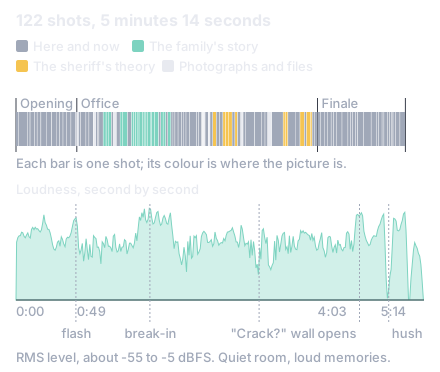
In numbers:
- 122 shots in 5 minutes 14 seconds: a mean of 2.57 s and a median of 2.29 s. Four shots run past 6 s, and each is a face at a turn in the story (shot length).
- Two set-ups of one character alone, called singles, carry 26 of the 39 shots inside the office. The wide shot that holds both characters, the A wide shot that holds everyone in the scene and shows where they stand., appears three times, and a low angle is held back until the sheriff has the answer (coverage).
- About five seconds of near silence before the killing blow, in a track whose loud passages sit 11 to 14 dB over its dialogue (sound).
- Three tools named, none of them Runway's, and a score and a mix by two people at a commercial music house (the record).
The film opens on a card, "Inspired by the Brothers Grimm: The Wolf and the Seven Young Goats" [1]. In the tale a wolf eats the kids, the mother cuts them out, and the wolf drowns in a well. Here a hare sheriff and a lynx detective stand over a wolf found dead at the bottom of a well in a trailer park. The festival's synopsis: "A tragic accident - or so they say. But when a sharp-witted hare starts to investigate, the truth shifts" [2]. The goats are the criminals and the wolf is the victim.
The table splits the film into its three parts. Look at the Shots and Speech columns: the office takes 80 of the 122 shots and nearly all of the words, and the finale has no words at all.
| Part | Time | Shots | Mean shot | What happens | Speech |
|---|---|---|---|---|---|
| Opening | 0:00 to 0:49 | 16 | 3.06 s | A drive, the titles, the arrival, the body | 20 words of narration |
| Office | 0:49 to 4:03 | 80 | 2.43 s | The two argue the case over the photographs | 283 words |
| Finale | 4:03 to 5:14 | 26 | 2.73 s | The hare goes back alone, climbs down, and finds out | none |
| Credits | 5:14 to 5:29 | Black, then one last picture | none |
The makers. Dorian Lebherz and Daniel Titz are commercial directors, represented in the US, the UK, Germany and France [3], who met at film school in 2012 and are based in Berlin and Vancouver [4]. Their agent's biography lists five D&AD pencils, four Clios and three Cannes Lions for one Samsung campaign [4]. They are not newcomers who found a model; they are directors with a decade of paid work who picked up a new camera.
The tools. One sentence is on record, a reporter's paraphrase of an interview: "The project took years to make, evolving along with the technology; first, using early platform ComfyUI, then more recent image generators Kling 3.0 and Nano Banana" [5]. Kling is a video model and Nano Banana an image model, so the likely reading is stills first, then stills animated, which is how the duo described making an earlier short: an image workflow in ComfyUI on FLUX, a custom A small add-on trained on a few dozen pictures so that an image model keeps drawing the same character or style. for the lead, Daniel Titz's own photographs "to guide the light and style", and Photoshop to finish each still [6]. No Runway model is named anywhere, and the festival did not ask for one: its rules call for video made with "tools similar to Runway's" [7].
The score and the sound. The makers' own uploads carry no credits, and the festival page lists only the directors. The film's end cards do carry two: "Music by Bernhard Pausch, Supreme Music" and "Sound by Moritz Irion, Supreme Music". Supreme Music is a German company that makes music and sound for advertising and film; Pausch is a composer and producer on its staff [8] and Irion an audio engineer in its post-production division [9]. So the two things a viewer hears under the voices, the score and the mix, are human work from the same commercial world the directors come from.
The volume of work. No count is published for this film. A collaborator of the duo finished her own short the same spring, with tools that include the two named last for The Well, and published hers: about 2,490 images and 2,010 videos generated for 192 shots in the cut, over about 205 hours [10]. That is 13 stills and 10 clips made for each shot kept. "99.9% of video clips started from an image, not from text alone" [10].
As of Nov 11, 2026, nothing else is published: no voice credit, no editor, no grade, no team size.
Nothing is on record about the voices, and no cast is credited. Three things can be said.
The faces move with the words. On the lynx's longest close-up (7.5 s), the frame-to-frame change in the face tracks the loudness of the speech with a correlation of 0.73 and no lag; on the hare's longest (9.3 s) it is 0.65. The face moves about twice as much while a line is spoken as between lines. A silent clip with a voice laid over it afterwards would not show that. A shot generated together with its line would, and so would a shot driven by a recorded performance.
The tool can do either. Runway's model list describes Kling 3.0 Pro as image to video of 3 to 15 seconds "with optional audio" [11], and its motion-control mode "transfers full-body movement, hand gestures, and facial expressions from the reference video to the character in your image" [12].
The nearest precedents put a person in the chain. On the duo's previous short, the same collaborator "recorded real voice performances and ran them through ElevenLabs' voice changer to get human-grounded dialogue" [10]. The festival's Grand Prix winner went the other way round: its festival listing, read here from a search excerpt, describes dialogue generated with the picture and then redubbed through a voice tool so that one character keeps one voice [13]. The vendor's own documents say why a read beats a script: its voice changer keeps "the performance nuances of the original" [14], while the tags that steer its text-to-speech model are "not perfect yet" [15].
So the honest answer is that the method is unknown, and the likely one is a recorded read, by an actor or by the directors, somewhere under each line.
What can be measured is the delivery. The office scene has 283 words in 190 seconds, 89 words for each minute of the scene, with 17 gaps of more than three seconds between words and three of about eight. A study of subtitle timings puts the typical gap between lines in recent films at about two seconds, half what it was in the early 1960s [16]. The film talks like an older film. Editor Chris McCaleb's phrase for it is "spending some time in that silence" [17].
- Fast for a feature. Average shot length in Hollywood films fell "to below 4 s after 2000" [18]; David Bordwell finds it not "uncommon to find films with average shot lengths of 2-4 seconds" [19]. One editor's count gives David Fincher's features a mean of 3.87 s, with The Girl with the Dragon Tattoo at 3.2 s [20]. The Well's 2.57 s is quicker than all of them.
- No long tail. In Barry Salt's examples the median shot is about half the mean, because a few long takes pull the mean up [21]. Here the median is 0.89 of the mean. 82 of the 122 shots last between one and three seconds, eight are under a second, and four are over six.
- The four long shots are faces at turns in the story: the hare working it out (9.3 s), the lynx's "just another dead crackhead" (7.5 s), the hare walking into the hidden room (6.3 s), the lynx's "how did he end up down there dead?" (6.0 s). Fincher's editor Kirk Baxter describes the same spending: "move closer in as we get to the point of a scene, and then deliver your punch-in-the-nose in a big fat close up" [22].
- Every shot fits inside one generated clip. The longest is 9.3 s; Kling 3.0 clips run to 15 s [11]. Nothing in the film needed two clips joined.
| Size | Shots | Seconds |
|---|---|---|
| Medium close-up | 26 | 68 |
| Close-up | 25 | 74 |
| Medium | 25 | 61 |
| Insert (an object, a photograph, feet) | 23 | 44 |
| Wide | 18 | 51 |
| Extreme wide | 3 | 13 |
| Extreme close-up (both are eyes) | 2 | 3 |
The camera is nearly still. About 15 shots are locked off, about 30 drift slightly, about a third carry a slow push in, and nine are handheld: the wolf's break-in, his exit and his fall. There is no whip pan and no zoom. Camera operator Peter Rosenfeld on working for Fincher: "The camera never moves unless it's motivated" [23].
The office scene is 39 shots of two characters in one room, covered from eight positions:
| Set-up | Uses | Time |
|---|---|---|
| Hare alone, from below, window behind | 15 | 42.6 s |
| Lynx alone, close, map out of focus behind | 11 | 32.8 s |
| Lynx in profile, lamp behind | 3 | 5.8 s |
| Both, wide and locked off (the master) | 3 | 6.0 s |
| From the ceiling, through a fan | 1 | 1.5 s |
| Hare from the front, bending over the desk | 1 | 2.6 s |
| Hare from desk height, ceiling light behind | 3 | 14.8 s |
| Lynx from desk height | 2 | 7.7 s |
- This is the studio norm. Bordwell, on a 1998 studio comedy: "Nearly every line or reaction ... gets a shot to itself", and the "sustained two shot is practically an endangered species" [19]. The master appears at three changes of direction in the argument and nowhere else.
- The low angle is saved. Neither desk-height set-up is seen until 3:26, when the hare says "The ice down there. It was thin." From there to the scene's last shot the room is seen only from below.
- The line leads the picture. One question runs over three pictures: "And they didn't" (a case file), "see or hear" (the master), "the fight?" (the hare). Baxter: "I try to let the dialogue lead the picture edits"; cut on every line and "it ends up looking like a porno" [22].
- Eight of the 39 shots are silent looks, three of them in a row (6.4 s) before "I'm not buying it."
- The hare stays frame left and the lynx frame right for the whole scene.
For a generated film the table has a second meaning. A set-up used 15 times is one framing, one light and one background to get right once, and it is the same picture every time the film returns to it.
| Where the picture is | Shots | Time |
|---|---|---|
| The office | 39 | 113.8 s |
| The family's story, as the lynx repeats it | 20 | 41.1 s |
| The sheriff's theory | 12 | 24.3 s |
| Photographs and file pages | 9 | 14.9 s |
- It is an old device. Bordwell describes the flashback that is "a sort of visual illustration of what is told", often "testimony in a trial or investigation" [24], and, in Knives Out, a detective's own reconstruction of the same night with one action changed [25].
- The room is never left alone for long. The longest unbroken stay in the office is 24.9 seconds; most are under ten.
- The voice carries on over the pictures. The lynx's account of the break-in runs 44 seconds across 22 shots, and five of them are his own face.
- The picture arrives on its noun. "That guy who was chopping wood nearby" and the boar is on screen; "on the couch watching TV" and the television is. Bordwell calls a line answered by a picture a "dialogue hook" [26].
- Each version has its own look. The room is green-grey, locked off and quiet. The family's story is the warmest and loudest thing in the film, and its violence is handheld. The sheriff's theory is cold, still, and at one point two cuts of a third of a second each. Mindhunter's colourist describes the habit: "let each scene or location live as a 'postcard' unto itself" [27].
Cutting's measurements of Hollywood films found, in Bordwell's summary, "the absence of 'lingering' punctuation by fade-outs or dissolves" [28]. The Well has none before its credits. What it uses instead:
- A light and an object (0:44). The torch finds the body at the bottom of the well; from inside the well the torch swings into the lens and whites out the frame (0.4 s); the body appears as a photographic negative (0.5 s); then as a print on a desk; then the office from the ceiling. Place and time change on one object. Bordwell: "An image can hook to an image. This is rarer" [26]. The sound falls 16 to 19 dB across it.
- A word. The dialogue hooks above.
- A photograph. A print sits between the room and the event it records, in both directions.
- A thought (3:35). Paws hit the ice (0.4 s), the ice stars (0.3 s), blood, the wolf's head: the sheriff's idea at the speed he has it.
- A line to a landscape (4:03). "I got to go." Cut to the forest from the air. Bordwell's example of the same join is a line, then "the dome of the Library of Congress" [26].
- Black (5:14). A push into the goat father's glasses on a crescendo, then black and digital silence.
One picture returns five times: the disc of light at the top of the well, seen from below under the opening credit, in the family's story and when the hare climbs down, and from above when the body is found and under the last credit.
- The frame is 2.40 to 1, letterboxed.
- The darkness. Cutting's group measured the median pixel value of every frame of 160 films and averaged it; the darkest was a 2010 Harry Potter film at 72.1 on a scale of 0 to 255 [18]. By the same measure The Well is 33.8: 49.0 in the opening, 32.5 in the office, 26.9 in the finale. (Their films were measured from DVDs and this one from a YouTube encode, so the comparison is approximate.)
- The sources. Every interior has its light in the frame or just outside it: a window behind the hare, a lamp behind the lynx, a ceiling fixture in the low angles, the mouth of the well. Neither detective is lit from the front. Erik Messerschmidt on Mindhunter: "Let the room light the actors" [29]. Jeff Cronenweth on Fight Club: "Faces were generally underexposed 1 and 1/2 to 2 stops" [30]. Roger Deakins: "as though somebody sitting in a room by a lamp is being lit by that lamp" [31].
- The palettes. Exteriors are cyan and drained, with the red of a patrol car's light as the only warm colour. The office is green-grey with one tungsten lamp. The trailer in the family's story is amber. The well and what is under it are blue-black. Darius Khondji on Seven: "a practical is usually orange with a ¼ to full CTO or a very cool green" [32].
- The focus. Shallow on the singles, deep on the wides.
Darkness is also kind to a generator. A face half in shadow has half as much to get wrong, and the file pages on the desk carry scribble under one readable word, on screen for under two seconds.
- The level. The upload measures -16.3 LUFS with a loudness range of 14.7 LU. YouTube plays back at a reference of -14 LUFS [33], so it is not turned down. Netflix's guidance for a programme's range is 4 to 18 LU [34]; the EBU notes that The Matrix at 25 LU "is probably challenging for most living rooms" [35]. This is a film mix sized for a laptop.
- The room. Voices sit in the centre over a thin held score and room tone. Between lines the track falls to about -35 dBFS. There is almost no bass in the office.
- The memories. The break-in runs at -7 to -15 dBFS for 25 seconds, with the bass 15 to 25 dB above the room's. The film's loudness follows its time layers.
- The hush. From 4:58 to 5:02 the goat father comes into focus behind the hare and the film cuts to the hare's eyes. The track drops to between -43 and -54 dBFS, its quietest point. The blow lands at -12. Sound editor Katie Maynard: "we'll usually cut out of anything we can to give a breath of silence before a huge hit" [36]. Mixer Michael Babcock: "you're pulling things out. So the next thing has a moment to really read" [37].
- The end. The last crescendo reaches -9 dBFS and is cut to black; two seconds later the track is at -79.
A generated film is in the position of an animated one. David Kamp, who scores and designs sound for animated shorts: "I usually start from silence since animation has no production sound" [38]. Everything heard in The Well was put there.
- The clue is shown before it is named. The ice at the bottom of the well is on screen at 0:44, in the torch beam, and again as a print at 1:19. It becomes a clue at 3:16. S. S. Van Dine's first rule: "The reader must have equal opportunity with the detective for solving the mystery" [39]. Bordwell on the same tradition: information planted to be "neglected by the reader ('I should have noticed that!')" [25].
- A word solves it. "Just another dead crackhead." "Crack? ... The ice." The pun is doing double work, since ice is also what is being cooked under the well. The hare's shot for "Crack? ... The ice." lasts 5.7 seconds.
- The tale is planted in the film. The goat kids are watching an old cartoon of a wolf chasing kids when the wolf comes through the door.
- The last 71 seconds have no words. The hare walks, climbs, looks, presses a stone, and understands; the picture carries all of it.
- The end returns to the start. Under the last credit, a body lies at the bottom of the well, seen from above, as the wolf's was. Baxter on Gone Girl: "there's actually a lot of bookending ... You visually see it blocked and staged the same way" [40].
Read off the shot log:
- No human face and no human hand. A paw holds a notebook, a torch and a bat, each in one short shot.
- No long action. The killing is a wind-up (1.3 s), a blur (0.46 s), a follow-through (1.5 s) and a body on the floor.
- Nobody talks while moving through a space.
- No text to read beyond one header.
- The fastest motion is the hardest to inspect: handheld, backlit, full of dust, under three seconds a shot.
Other film-makers say this aloud. Yonatan Dor: "We on purpose select styles that are destroyed in the first place" [41]. Léo Cannone set a festival film inside a child's camcorder, "overexposed, sun-bleached, slightly soft" [42]. And the volume is real work: the Grand Prix winner's "biggest lesson has been that prompting is not directing" [43]; of a Sundance short made with Google's models, "No final shots were 'one-click' generations" [44].
These are inferences from the measurements, not the makers' statements.
- Write for the tools. Characters whose faces forgive, a story of talk and stillness, action that happens in the cut.
- Plan set-ups, not shots. List the six to nine camera positions a scene needs, make one reference still for each, and return to them.
- Give every line a picture. Decide for each phrase whether the film is on the speaker, on the listener, or on the thing being named.
- Mark the holds first. Keep most shots between one and three seconds and spend the few long ones on faces at turns.
- Cut straight, and choose a hook for every scene change: a word, an object, a light, or black.
- One palette for each place and each version of events, one visible source of light, faces kept under.
- Put a person under every line. Record the read, convert the voice if it must change, and make the picture to the recording.
- Compose the track. A score written to the cut, dialogue as the anchor, a bed of room tone under everything, the loud passages placed, and silence spent before the hit.
- Budget for selection. About 13 stills and 10 clips for each shot kept, on the one comparable film with published counts [10].
- Cuts. ffmpeg's scene-change score on every frame of the 1080p upload [1], then a second pass on contrast-equalised frames, which found four cuts hidden in the dark scenes. Each of the 122 shots was then read from its first, middle and last frame and tagged by hand for size, angle, set-up and time layer.
- Camera movement is an estimate from feature tracking between frames and is the least certain figure here; a moving subject can pass for a moving camera.
- Sound. EBU R 128 loudness, and RMS level for each half second in five frequency bands. Levels in dBFS are RMS, not peaks. The words and their times are from YouTube's automatic captions.
- Brightness. The median luma of every third frame inside the picture area, averaged.
- Not known: how the voices were made, who edited and graded the film, how many images and clips were generated, and which image model ran inside ComfyUI. The festival asked each entrant for "a short, written description of the AI techniques used" [7]; as of Nov 11, 2026, that description is unpublished.
- Another account exists. A third-party article of Sep 16, 2026 covers the film's tools from the same magazine sentence [45]. The numbers here were made independently of it.
What next
Run The Well again with the timeline from the top of this page beside it: the low angle from desk height first appears at 3:26, on the line about the thin ice, and the track falls to its quietest point from 4:58 to 5:02, just before the blow. The same four questions (shot, cut, light, sound) can be put to any generated short. One to try them on is The Last Trail, a 56 second AI-generated horror short by this page's author, released on Oct 29, 2026, before these measurements were made. Watch it on YouTube.
- How was a viral AI horror short made, and what does one like it cost?
- How are famous horror scenes like the Psycho shower built, shot by shot?
- How do horror films use sound and silence to scare you, and is any of it proven?
Part 4 of 4 in AI short filmsPrevious: Synthetic voices for a radio call
New research as it lands: the feed (RSS).
- [1]Runway, "The Well, Dorian & Daniel | Runway AI Festival 2026," YouTube, Jun. 19, 2026. Accessed: Nov. 11, 2026. [Online]. Available: https://www.youtube.com/watch?v=yBs_pMUDrrk
- [2]Runway, "AIF 2026," Runway AI Festival. Accessed: Nov. 11, 2026. [Online]. Available: https://aif.runwayml.com/
- [3]D. Lebherz and D. Titz, "About," Dorian & Daniel. Accessed: Nov. 11, 2026. [Online]. Available: https://doriandaniel.com/about.html
- [4]Wanda, "Dorian & Daniel: bio," Wanda Productions. Accessed: Nov. 11, 2026. [Online]. Available: https://wanda.net/directors/dorian-and-daniel/bio
- [5]A. Kaufman, "Putting the Art in Artificial," Filmmaker Magazine, Aug. 12, 2026. Accessed: Nov. 11, 2026. [Online]. Available: https://filmmaker.substack.com/p/putting-the-art-in-artificial
- [6]D. Titz, "Crafting Ava - an AI Short Film," Idlespace, Mar. 31, 2025. Accessed: Nov. 11, 2026. [Online]. Available: https://idlespace.ca/ava-chapter-one/
- [7]Runway, "Runway 2026 AI Festival Official Rules - Film," Runway AI Festival. Accessed: Nov. 11, 2026. [Online]. Available: https://aif.runwayml.com/terms-film
- [8]Supreme Music, "Bernhard Pausch: Composer," Supreme Music. Accessed: Nov. 11, 2026. [Online]. Available: https://www.suprememusic.de/crew/bernhard-pausch
- [9]Supreme Music, "Moritz Irion: Audio Engineer," Supreme Music. Accessed: Nov. 11, 2026. [Online]. Available: https://www.suprememusic.de/de/crew/moritz-irion
- [10]C. Kiessling, "How I purposefully shot myself in the foot making my latest short film," Idlespace, Apr. 20, 2026. Accessed: Nov. 11, 2026. [Online]. Available: https://idlespace.ca/how-i-purposefully-shot-myself-in-the-foot-making-my-latest-short-film/
- [11]Runway, "Available AI Models," Runway API documentation. Accessed: Nov. 11, 2026. [Online]. Available: https://docs.dev.runwayml.com/guides/models/
- [12]Runway, "Creating with Kling 3.0 Motion Control," Runway Help Center, Mar. 26, 2026. Accessed: Nov. 11, 2026. [Online]. Available: https://help.runwayml.com/hc/en-us/articles/50280558448147-Creating-with-Kling-3-0-Motion-Control
- [13]R. Gaudette, "A Face Only A Mother Could Love," FilmFreeway. Accessed: Nov. 11, 2026. [Online]. Available: https://filmfreeway.com/AFaceOnlyAMotherCouldLove
- [14]ElevenLabs, "Voice changer," ElevenLabs documentation. Accessed: Nov. 11, 2026. [Online]. Available: https://elevenlabs.io/docs/capabilities/voice-changer
- [15]ElevenLabs, "Prompting Eleven v3," ElevenLabs documentation. Accessed: Nov. 11, 2026. [Online]. Available: https://elevenlabs.io/docs/best-practices/prompting/eleven-v3
- [16]S. Follows, "Has the way movies use dialogue changed?," Stephen Follows, Apr. 21, 2025. Accessed: Nov. 11, 2026. [Online]. Available: https://stephenfollows.com/p/has-the-way-movies-use-dialogue-changed
- [17]Y. Baranovsky, "How To Edit With Silence, From TV Editor Chris McCaleb," Frame.io Insider, May 8, 2017. Accessed: Nov. 11, 2026. [Online]. Available: https://blog.frame.io/2017/05/08/edit-with-silence/
- [18]J. E. Cutting, K. L. Brunick, J. E. DeLong, C. Iricinschi, and A. Candan, "Quicker, faster, darker: Changes in Hollywood film over 75 years," i-Perception, vol. 2, no. 6, pp. 569-576, 2011. Accessed: Nov. 11, 2026. [Online]. Available: https://pmc.ncbi.nlm.nih.gov/articles/PMC3485803/
- [19]D. Bordwell, "Intensified continuity revisited," Observations on Film Art, May 27, 2007. Accessed: Nov. 11, 2026. [Online]. Available: https://www.davidbordwell.net/blog/2007/05/27/intensified-continuity-revisited/
- [20]V. Nedomansky, "Revealing Every Single Shot in 'Gone Girl' & 'Girl With the Dragon Tattoo' in 1 Image," VashiVisuals, Aug. 7, 2017. Accessed: Nov. 11, 2026. [Online]. Available: https://vashivisuals.com/?p=6888
- [21]B. Salt, "Graphs and Numbers," Cinemetrics. Accessed: Nov. 11, 2026. [Online]. Available: https://cinemetrics.uchicago.edu/article/4bae8cac-cceb-452a-b6e6-1aa2df4fa76a
- [22]S. Hullfish, "Art of the Cut on editing Mindhunter with Kirk Baxter, ACE and Tyler Nelson," ProVideo Coalition, Dec. 21, 2017. Accessed: Nov. 11, 2026. [Online]. Available: https://www.provideocoalition.com/aotc-mindhunter
- [23]J. Light, "Camera Operating for David Fincher: 40 Takes and No Pans," No Film School, Oct. 13, 2026. Accessed: Nov. 11, 2026. [Online]. Available: https://nofilmschool.com/david-fincher-never-pans
- [24]D. Bordwell, "Grandmaster flashback," Observations on Film Art, Jan. 27, 2009. Accessed: Nov. 11, 2026. [Online]. Available: https://www.davidbordwell.net/blog/2009/01/27/grandmaster-flashback/
- [25]D. Bordwell, "Enter Benoît Blanc: KNIVES OUT as murder mystery," Observations on Film Art, Aug. 4, 2022. Accessed: Nov. 11, 2026. [Online]. Available: https://davidbordwell.net/blog/?p=48988
- [26]D. Bordwell, "The Hook: Scene Transitions in Classical Cinema," David Bordwell's website on cinema, Jan. 2008. Accessed: Nov. 11, 2026. [Online]. Available: https://www.davidbordwell.net/essays/hook.php
- [27]FilmLight, "Creating a unique HDR look for 'Mindhunter': A Q&A with producer Peter Mavromates and colourist Eric Weidt," FilmLight, 2017. Accessed: Nov. 11, 2026. [Online]. Available: https://www.filmlight.ltd.uk/pdf/casestudies/CS_Mindhunter.pdf
- [28]D. Bordwell, "Movies by the numbers," Observations on Film Art, Jul. 14, 2022. Accessed: Nov. 11, 2026. [Online]. Available: https://www.davidbordwell.net/blog/?p=48879
- [29]H. DuBois, "Why David Fincher's 'Mindhunter' DP Believes 'There Are No Rules' in Lighting," No Film School, Oct. 13, 2017. Accessed: Nov. 11, 2026. [Online]. Available: https://nofilmschool.com/2017/10/mindhunter-dp-discusses-how-there-are-no-rules-lighting
- [30]C. Probst, "Fight Club: Anarchy in the U.S.A.," American Cinematographer, Nov. 1999. Accessed: Nov. 11, 2026. [Online]. Available: https://theasc.com/articles/flashback-fight-club
- [31]NPR, "Roger Deakins, Keeping An Eye On The Small Things," All Things Considered, Oct. 29, 2009. Accessed: Nov. 11, 2026. [Online]. Available: https://www.npr.org/2009/10/29/114249616/roger-deakins-keeping-an-eye-on-the-small-things
- [32]D. E. Williams, "Seven: Sins of a Serial Killer," American Cinematographer, Oct. 1995. Accessed: Nov. 11, 2026. [Online]. Available: https://theasc.com/articles/flashback-seven-1995
- [33]I. Shepherd, "YouTube Changes Loudness Reference to -14 LUFS," MeterPlugs, Sep. 18, 2019. Accessed: Nov. 11, 2026. [Online]. Available: https://www.meterplugs.com/blog/2019/09/18/youtube-changes-loudness-reference-to-14-lufs.html
- [34]Auphonic, "Dialog loudness normalization," Auphonic Blog, Oct. 8, 2020. Accessed: Nov. 11, 2026. [Online]. Available: https://auphonic.com/blog/2020/10/08/dialog-loudness-normalization/
- [35]European Broadcasting Union, "Guidelines for production of programmes in accordance with EBU R 128," EBU Tech 3343, ver. 4, Nov. 2023. Accessed: Nov. 11, 2026. [Online]. Available: https://tech.ebu.ch/docs/tech/tech3343.pdf
- [36]T. Vindigni, "Lesson Learned: The Power In Less," Boom Box Post, Mar. 3, 2020. Accessed: Nov. 11, 2026. [Online]. Available: https://boombox-post.squarespace.com/blog/2020/2/27/wip
- [37]J. Light, "How 'Heretic's Sound Team Plays with Fear and Silence," No Film School, Nov. 20, 2024. Accessed: Nov. 11, 2026. [Online]. Available: https://nofilmschool.com/heretic-sound-design
- [38]R. Munday, "The Importance of Sound with David Kamp," Short of the Week, Jul. 24, 2023. Accessed: Nov. 11, 2026. [Online]. Available: https://www.shortoftheweek.com/news/the-importance-of-sound-david-kamp
- [39]S. S. Van Dine, "Twenty Rules for Writing Detective Stories," The American Magazine, Sep. 1928. Accessed: Nov. 11, 2026. [Online]. Available: https://www.umsl.edu/~gradyf/film/vandinerules.htm
- [40]I. Failes, "Maintaining the mystery: editor Kirk Baxter on Gone Girl," fxguide, Oct. 2, 2014. Accessed: Nov. 11, 2026. [Online]. Available: https://www.fxguide.com/fxfeatured/maintaining-the-mystery-editor-kirk-baxter-on-gone-girl/
- [41]W. Smith, "The Dor Brothers Generate Fifty Clips and Keep Two," The Daring Creatives, Sep. 23, 2026. Accessed: Nov. 11, 2026. [Online]. Available: https://www.thedaringcreatives.com/creator-stories/the-dor-brothers-fifty-clips-keep-two/
- [42]W. Smith, "Léo Cannone Tells His AI Stories Through a Child's Camera," The Daring Creatives, Oct. 14, 2026. Accessed: Nov. 11, 2026. [Online]. Available: https://www.thedaringcreatives.com/creator-stories/leo-cannone-nonna-gigante-ai-series/
- [43]D. Allegretti, "'Prompting is not directing': how Robert Gaudette turned a drawer full of scripts into an AI film sweeping awards," Envato Elements, Jul. 29, 2026. Accessed: Nov. 11, 2026. [Online]. Available: https://elements.envato.com/learn/a-face-only-a-mother-could-love
- [44]VP Land, "Google Premieres AI-Animated Short at Sundance, Demonstrates New Workflow for Creative Control," VP Land, Jan. 29, 2026. Accessed: Nov. 11, 2026. [Online]. Available: https://www.vp-land.com/stories/google-premieres-ai-animated-short-at-sundance-demonstrates-new-workflow-for-creative-control
- [45]W. Smith, "Dorian & Daniel Started The Well in ComfyUI and Finished It in Kling," The Daring Creatives, Sep. 16, 2026. Accessed: Nov. 11, 2026. [Online]. Available: https://www.thedaringcreatives.com/creator-stories/dorian-daniel-the-well-ai-short-film/